You don't rise to the occasion. You fall back on your patterns.
The S.C.E.N.E. Framework provides a practical system for creating clarity, influence and execution.

The path to your potential
Every transformation starts with an honest understanding of the current situation. Each of us lives in his or her reality, each company, each team is in a current state - often on the one hand defined by certain (often also missing) structural processes, resp. inefficiency and on the other hand defined by a certain human perspective, state and skill set.
The Human Potential Framework S.C.E.N.E. assesses where your blind spots are and evokes the most efficient way to reach your potential in all necessary areas.
S.C.E.N.E. - The Human Potential Framework
S.C.E.N.E. is the working framework through which I structure my work on human potential, performance and decision-making under pressure.
Through this simple framework we can analyse the current situation in five human dimension.
Each dimension focuses on different capabilities which all together determine whether decisions, communication and leadership hold up when stakes rise.
Depending on your needs and current situation, I will focus on certain dimensions to help you reach your true human potential in an efficient and objective manner.
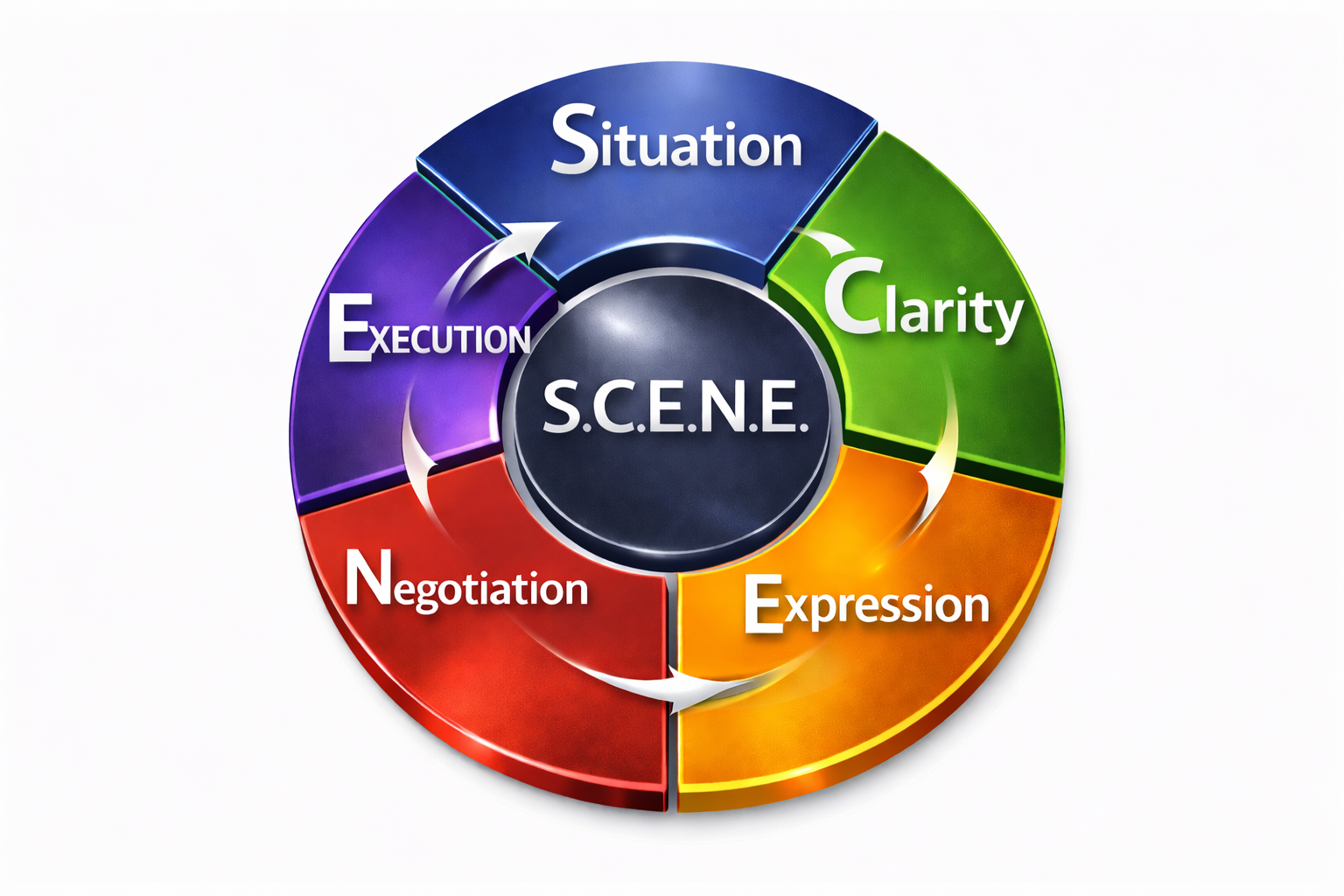
The five pillars
S - Situation
Human perception, business reality & contextual dynamics
Human perception, business reality & contextual dynamics
- Assessment of context, constraints and underlying dynamics
- Identification of cognitive bias and emotional triggers under pressure
- Precise mapping of stakeholders, interests and leverage
C- Clarity
Decision quality in complexity and ambiguity
Decision quality in complexity and ambiguity
- Strategic direction anchored in values and long-term objectives
- Priority-setting and recalibration in volatile environments
- Assertiveness while emotionally grounded
E - Expression
Language, voice and presence as instruments of influence
Language, voice and presence as instruments of influence
- Executive presence: calm authority through voice, posture and timing
- Clear articulation, framing and story telling that turns intention into impact
- Listening & resonance: Read the room and convey emotions
N - Negotiation
Handling conflict and competing interests in high-stakes interactions
Handling conflict and competing interests in high-stakes interactions
- Negotiation power: Strategies and tactics to influence
- Constructive handling of disagreement and critical conversations
- Practice under pressure to achieve outcomes with integrity
E - Execution
Translating insights into durable behavioural change
Translating insights into durable behavioural change
- Embedding change through structured feedback and reflection
- Translation of learnings into real-life and consistent performance
- Build habits that sustain longterm impact
Why does S.C.E.N.E. matter?
S - Situation
If neglected →
Perception narrows. Blind spots increase. Decisions rely on incomplete reality.
If addressed →
Context is assessed clearly. Risk becomes visible. Decisions gain stability.
C - Clarity
If neglected →
Priorities blur. Decision paralysis. Strategic momentum slows.
If addressed →
Direction sharpens. Energy aligns. Decisions move forward with consistency.
E - Expression
If neglected →
Strong thinking fails to translate. Credibility weakens. Alignment suffers.
If addressed →
Communication drives execution. Authority becomes visible. Trust deepens.
N - Negotiation
If neglected →
Relationship weaken. Conflict escalates. Tension becomes financially costly.
If addressed →
Leverage increases. Agreements hold. Outcomes remain constructive.
E - Execution
If neglected →
Insight remains theoretical. Behaviour stays unchanged. Progress stalls..
If addressed →
Change embeds. Accountability strengthens. Momentum builds.